


 العربية
 Indonesia
 ไทย
 Tiếng Việt
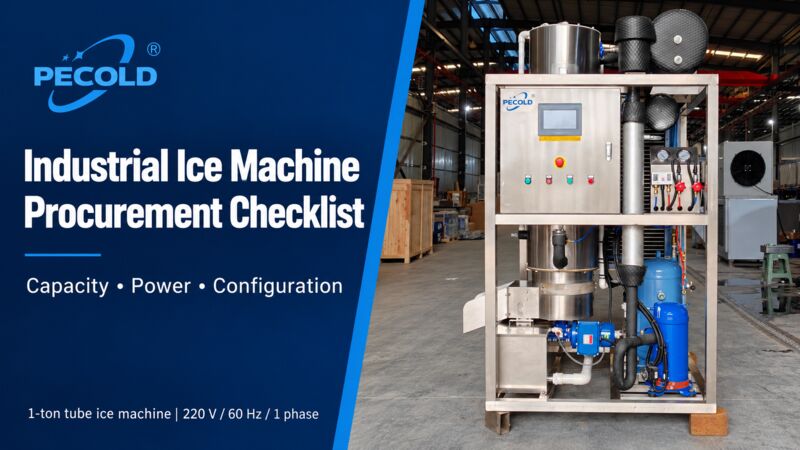
Before ordering an industrial ice machine from China, turn the supplier’s quotation into a documented specification. Confirm the required output, rating conditions, electrical configuration, cooling arrangement, included equipment, installation responsibilities, and factory records.
For contractors, procurement teams, and distributors, these details help establish whether a proposal matches the end user’s project. Two quotations describing a “1-ton ice machine” may cover different configurations and supply scopes.
Use this industrial ice machine procurement checklist to review proposals before placing an order. If the project has not yet selected an ice type, start with our industrial ice machine selection guide, then return to this checklist for the quotation review.
1. Define the Project Requirements Before Comparing Quotations
Give each supplier the same project brief. Include the application, required ice shape and dimensions, normal and peak daily demand, production hours, and installation location.
Explain how the ice will move through the operation. Will it be used immediately, stored for later collection, or packaged for distribution? These requirements determine which supporting equipment must be included in the project.
Avoid requesting only a machine price. Ask suppliers to identify the proposed model, configuration, rating conditions, and exclusions against your brief.
2. Check Rated Output Together with Its Operating Conditions
A daily production figure needs a defined basis. Request ambient temperature, inlet water temperature, cooling method, and the method used to establish output.
The following PECOLD configurations illustrate the information to request:
| Specification | 1-Ton Tube Ice Configuration | 2-Ton Flake Ice Configuration |
|---|---|---|
| Rated output | 1,000 kg/24 h | 2,000 kg/24 h |
| Standard ambient temperature | 28°C | 25°C |
| Standard inlet water temperature | 23°C | 15°C |
| Cooling method | Air-cooled | Air-cooled |
| Power supply | 220 V / 60 Hz / single-phase | 380 V / 50 Hz / three-phase |
| Total installed power | 5.1 kW | 8.1 kW |
These are two specific configurations with different rating conditions. They are not a comparison of energy efficiency or interchangeable options for the same application.
Provide the supplier with the expected site conditions and request written confirmation of the proposed equipment’s suitability.
Distinguish Calculated Output from a Full-Day Test
For PECOLD’s supplied 1-ton tube ice example, the complete production cycle is 28 minutes and the measured ice harvest is 20 kg.
Equivalent daily output = 1,440 ÷ 28 × 20 ≈ 1,028.6 kg/24 h
This calculation projects daily output from a complete cycle and measured harvest weight. It does not mean that 1,028.6 kg was collected during a continuous 24-hour test.
The specified 2-ton flake ice machine produces continuously and has a rated output of 2,000 kg/24 h under its stated conditions. Agree on how output will be verified and recorded rather than assuming every capacity figure comes from the same test method.
3. Verify the Complete Electrical Specification
Check voltage, frequency, and phase together. A site with a 220 V supply does not automatically match every machine described as operating at 220 V.
The example tube ice configuration uses single-phase 220 V at 60 Hz, while the flake ice configuration uses three-phase 380 V at 50 Hz.
Ask for the selected machine’s electrical documentation and any starting-current information needed for installation. The buyer’s local electrician should verify the available supply and determine the required connection and protection arrangements.
Keep installed power separate from energy consumption. A figure expressed in kW is not a measured consumption figure in kWh per tonne of ice.
4. Confirm the Cooling Arrangement and Its Supply Boundary
For air-cooled equipment, check the proposed location’s ventilation and follow the model-specific airflow and clearance requirements. PECOLD air-cooled machines do not require a cooling tower.
For water-cooled equipment, identify the cooling tower, associated connections, and water inlet and outlet piping. Reserve a suitable tower location before delivery.
PECOLD generally recommends considering water cooling for projects above 5 tonnes per day. This is a project-selection guideline, not a universal rule. Confirm the cooling configuration offered for the actual model.
Cooling towers are purchased separately from PECOLD’s ice machines. Ask the quotation to state which tower, pump, piping, and connection items are included or excluded.
5. Request an Itemized Configuration and Equipment List
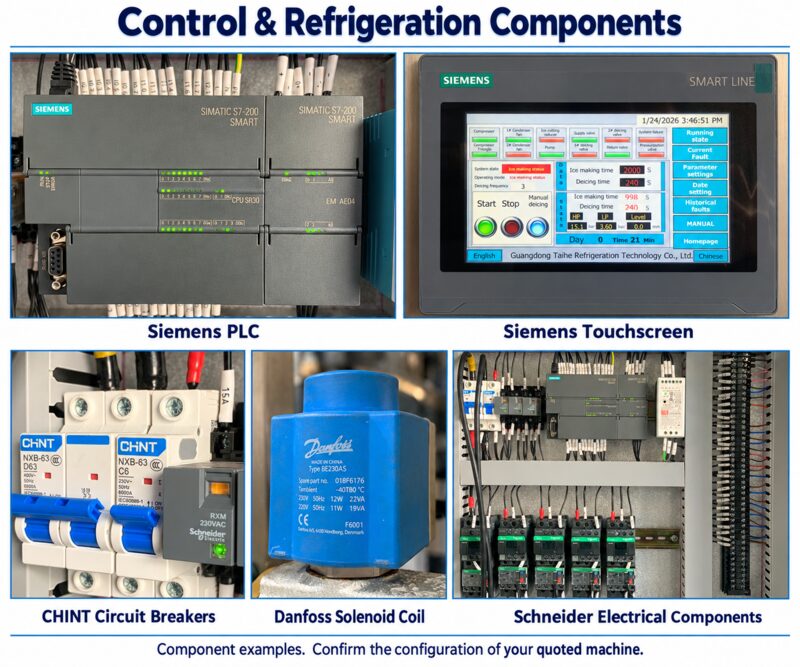
A compressor brand is only one part of the specification. Request the compressor model, condenser arrangement, controls, refrigerant, and relevant component materials.
For example, the supplied 1-ton tube ice configuration lists a Danfoss compressor, while the 2-ton flake ice configuration lists Copeland. These examples should not be treated as the standard compressor selection for every PECOLD machine.
Use the tube ice machine range or flake ice machine range to identify relevant equipment, then obtain a configuration sheet for the quoted unit.
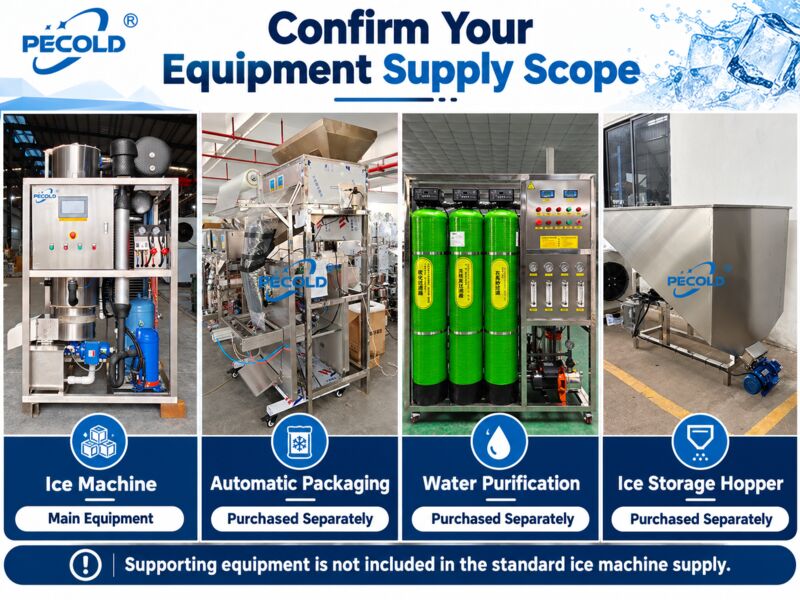
PECOLD’s standard ice machine supply excludes water purification, ice storage, and packaging equipment. These are available for separate purchase through PECOLD. A coordinated package should still list each item and its price or inclusion status clearly.
6. Assign Installation and Startup Responsibilities
Before shipment, confirm equipment dimensions, delivery access, service space, water supply, drainage, and electrical preparation.
The project should identify who will complete local electrical work and piping connections. Water-cooled installations also need the cooling tower and its associated connections ready for commissioning.
PECOLD provides online installation guidance through video calls or written communication. For first startup, PECOLD requires 12 hours of powered preheating with the compressor remaining off. Follow the supplied machine-specific instructions when performing this step.
Include this preparation period in the commissioning schedule instead of planning immediate production when the equipment arrives.
7. Agree on Factory Records and Acceptance Requirements
Specify the records needed before shipment. PECOLD’s stated factory checks include batch harvest weight where applicable, operating conditions, compressor operation, and condenser cleanliness. Factory records and relevant videos can support the handover.
Ask the supplier to distinguish measured results, calculated output, and rated specifications. Agree on any additional witnessed inspection or performance test before ordering.
Review conformity documents against the purchased configuration. PECOLD holds EMC Verification of Conformity document CTGS506230909EC for the equipment identified in that document. Confirm its applicability to the selected model and electrical specification rather than assuming that one document covers every configuration.
Final Quotation Review Checklist
Before approving the order, confirm that the proposal answers these questions:
| Review Item | What Should Be Confirmed? |
|---|---|
| Application | Ice type, dimensions, intended use, and handling method |
| Output | Required capacity, rating conditions, and verification method |
| Electrical supply | Voltage, frequency, phase, and connection requirements |
| Cooling | Air or water cooling, site requirements, and tower scope |
| Configuration | Named components and specifications for the quoted unit |
| Accessories | Included, optional, and excluded equipment |
| Installation | Buyer and supplier responsibilities, including startup preparation |
| Acceptance | Agreed checks, records, videos, and applicable documents |
A complete quotation should connect the proposed equipment to the project requirements and make exclusions visible.
Send PECOLD your project requirements for a configuration proposal. Include the application, daily ice demand, required ice dimensions, confirmed electrical supply, installation conditions, and any purification, storage, or packaging needs.