


 العربية
 Indonesia
 ไทย
 Tiếng Việt

An industrial ice machine’s electricity cost depends on its electrical input, operating hours and local electricity rate. For an initial budget, PECOLD’s PE1T-R4A 1-ton tube ice machine lists 5.1 kW of installed power. Assuming a constant 5.1 kW input for 24 hours gives 122.4 kWh, or USD 18.36 at an illustrative rate of USD 0.15/kWh.
This is a calculation based on installed power, not a measured daily consumption figure. Actual electricity use should be checked with a meter, while water treatment, refrigerated storage and packaging equipment need their own allowance.
The example below shows how to build that budget and relate it to the amount of ice produced.
Which Machine Specifications Matter for the Calculation?
Start with the configuration you are buying. Machines with the same nominal daily capacity can have different compressors, cooling arrangements and electrical requirements.
The supplied PECOLD configuration sheet lists:
| Specification | PECOLD PE1T-R4A |
|---|---|
| Rated ice production | 1,000 kg/24 h |
| Total installed power | 5.1 kW |
| Compressor input power | 3.7 kW |
| Cooling capacity | 9.2 kW |
| Cooling method | Air-cooled |
| Electrical supply | 220 V / 60 Hz / single-phase |
| Tube ice diameter | 35 mm |
| Standard ambient temperature | 28°C |
| Standard inlet water temperature | 23°C |
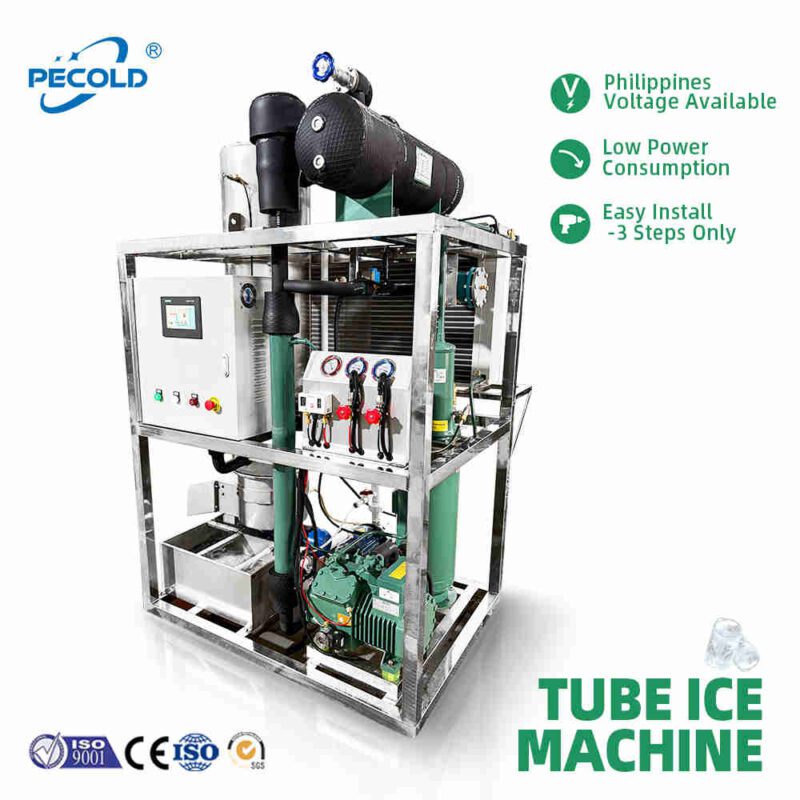
Use the electrical power figure for a preliminary electricity calculation. The 9.2 kW cooling capacity describes heat removal, so it should not be substituted for electrical input.
Compressor power alone also leaves out other electrical loads, such as the condenser fan, water pump and ice cutter. Confirm what the quoted total includes before adding accessories.
How Do You Estimate Daily and Monthly Electricity Costs?
The basic calculation is:
Electricity use, kWh = Average electrical input, kW × Operating hours
Electricity cost = Electricity use, kWh × Local price per kWh
For this preliminary example, assume the listed 5.1 kW remains constant throughout 24 hours:
5.1 × 24 = 122.4 kWh
Applying different illustrative electricity rates gives:
| Electricity rate | Calculated daily electricity cost | Cost for 30 operating days |
|---|---|---|
| USD 0.10/kWh | USD 12.24 | USD 367.20 |
| USD 0.15/kWh | USD 18.36 | USD 550.80 |
| USD 0.20/kWh | USD 24.48 | USD 734.40 |
These rates demonstrate the calculation; they are not tariffs for a particular country. Replace them with the rate applicable to your installation.
If your tariff changes by time of day, calculate peak and off-peak consumption separately. Check whether demand charges, fixed fees or taxes also apply. The energy charge may be only one part of your electricity bill.
Once the equipment is running, replace the assumed consumption with the difference between start and end meter readings over a recorded period.
How Much Ice Does a 28-Minute Cycle Produce?
For the supplied 1-ton machine example, PECOLD reports approximately 19–20 kg per complete 28-minute production cycle.
The equivalent daily output is calculated as:
Daily output = 1,440 minutes ÷ Complete cycle time × Ice weight per cycle
| Ice collected per cycle | Calculation | Equivalent output |
|---|---|---|
| 19 kg | 1,440 ÷ 28 × 19 | Approximately 977 kg/24 h |
| 20 kg | 1,440 ÷ 28 × 20 | Approximately 1,029 kg/24 h |
This projects continuous production from the reported cycle figures. Water temperature, ambient temperature and interruptions can change the result.
The configuration sheet’s rating temperatures and the cycle observations are separate records. When checking performance for your project, request the conditions associated with the production record.
For a measured daily result, collect and weigh the ice produced during the same period used for the electricity readings.
What Is the Electricity Cost per Tonne of Ice?
Cost per tonne connects the electricity budget to production:
Electricity cost per tonne = Electricity cost ÷ Ice output in tonnes
Using the illustrative USD 18.36 daily electricity cost and the calculated output range above gives:
| Calculated daily output | Calculated electricity cost per tonne |
|---|---|
| Approximately 0.977 tonnes | Approximately USD 18.79 |
| Approximately 1.029 tonnes | Approximately USD 17.85 |
Both figures combine the constant-power assumption with projected output. They are planning estimates, not measured energy-efficiency results.
For an operating ice business, calculate cost per tonne sold as well. Ice lost during handling or remaining unsold does not contribute to sales in the same way as ice delivered to a customer.
Does Tube Ice Size Change the Production Calculation?
PECOLD’s supplied guidance gives the following approximate production times and ice lengths for the relevant tube ice arrangements:
| Tube ice diameter | Approximate ice length | Approximate production time |
|---|---|---|
| 22 mm | 40 mm | 18 minutes |
| 29 mm | 45 mm | 24–25 minutes |
| 35 mm | 50 mm | 28 minutes |
These times vary with water and ambient temperatures. Before using them in an output calculation, confirm whether the stated time covers the complete cycle, including harvesting.
A shorter cycle does not establish a lower electricity cost per tonne. You also need the ice weight and energy consumed during that cycle. The 19–20 kg harvest figure should not automatically be applied to every diameter.
Select the ice size required by your customers, then request the corresponding production information.
Which Supporting Equipment Should Be Included?
The ice machine’s electricity estimate does not cover every part of an ice business.
| Supporting equipment | Additional budget items |
|---|---|
| Water purification | Purchase cost, pump electricity, filters and treatment consumables |
| Refrigerated ice storage | Refrigeration electricity, storage capacity and handling |
| Conveying equipment | Equipment cost and motor electricity |
| Automatic packaging | Equipment, electricity and packaging materials |
| Cooling tower for a water-cooled model | Tower, associated pumps, water use and maintenance |
The PE1T-R4A example is air-cooled and does not require a cooling tower. PECOLD’s water-cooled machines require a separately purchased cooling tower.
Water purification, ice storage, conveying and packaging equipment are also purchased separately. PECOLD can supply these supporting items, with the selected equipment and supply scope identified in the quotation.
Check whether each auxiliary electrical load is already included in the supplier’s total before adding it to the calculation.
What Else Belongs in the Project Budget?
Keep startup investment and recurring expenses separate.
The startup budget should include the machine, selected accessories, freight, insurance, destination charges, installation and applicable import costs. Ask your freight forwarder and local customs adviser to confirm destination-specific charges.
Recurring expenses include electricity, water, labor, packaging, cleaning, maintenance, storage and delivery.
If you plan to sell ice, a payback estimate also needs realistic sales volumes, selling prices and operating days. A machine’s rated capacity should not be treated as guaranteed daily sales.
Our industrial ice machine procurement checklist explains the specifications and supply details to confirm before ordering.
Get the Right Configuration for Your Budget
PECOLD is the industrial ice equipment brand of Guangdong Taihe Refrigeration Technology Co., Ltd., based in Foshan, China. We manufacture tube, flake and block ice machines and supply supporting equipment for ice production projects.
Browse our industrial ice machine range. When requesting a quotation, include your required ice type and size, daily demand, planned operating hours, confirmed electrical supply and storage or packaging needs.
Providing your local electricity rate allows the operating-cost estimate to use the same configuration and equipment scope as your quotation.